Advertorial
UPDATE — Derila is currently available at a reduced price. Stock and pricing can change — check current availability on the website HERE
Published: April, 2026 | Reading time: 6 min
The Sleep & Spine Report
Your Pillow Is Hurting Your Neck - every single night.
Researchers have found that people who wake up with neck pain spend significantly more time in stressful sleep positions during the night — and that pillow height and shape play a decisive role

Researchers studying people in their own homes over two nights found something that stopped them cold: the people waking up with neck pain had spent significantly more of the night in positions that put their cervical spine under direct strain — without ever knowing it.¹
Here's the uncomfortable truth: the ordinary pillow on your bed holds your neck in a slightly misaligned position every single night
Your neck muscles quietly work against it — all night long. You don't feel it in the moment. You only notice it when the alarm goes off.
This explains why:
you wake up stiff — even though you slept enough
your neck takes minutes to "loosen up" each morning
new pillows rarely seem to make a lasting difference
the problem keeps coming back — no matter what you do at night
And according to different studies, this is just the beginning of the damage...

The Surprising "Pain Chain" Your Pillow Triggers Every Night
Researchers studying neck pain didn't just find that the wrong pillow causes stiffness.
They found something that goes deeper — and explains why so many people feel like the problem keeps spreading.
Here's what happens while you sleep:
When your head isn't properly supported, your neck muscles can't fully release. They stay in a low-level state of tension — not enough to feel in the moment, but enough to matter after seven or eight hours.
Researchers measuring muscle activity during sleep found that even small positional misalignments changed how actively the trapezius and surrounding muscles worked through the night.³ The muscles don't rest. They compensate. Quietly, continuously — until morning.
But it gets worse.
That tension doesn't stay isolated. Studies on sleep posture and waking symptoms show that people who reported neck pain also reported more shoulder stiffness, worse overall sleep quality, and greater daytime fatigue.¹ One area affects the next. The body doesn't experience pain in neat compartments.
The result — for many people — looks like this:
Morning stiffness that takes time to ease before the day can really start
Shoulder tension that builds through the day without an obvious cause
Sleep that feels unrefreshing — even when the hours add up
A sense that the problem is slowly getting worse, not better
What researchers consistently point to is this: as long as the head isn't supported in a neutral position during sleep, the same strain pattern repeats every single night.¹·²·³ .
Not because something is wrong with you — but because the mechanics haven't changed

Why the Problem Keeps Coming Back — No Matter What You Try
Most people with chronic morning neck pain have already tried something. A new pillow. Stretching. Physiotherapy. Maybe even massage or chiropractic treatment.
And the treatments help — for a while. Then the stiffness comes back.
Researchers have a straightforward explanation for this: temporary treatments don't change what happens during the eight hours you spend in bed every night.
🚨 You might recognize this pattern:
You get treatment, you feel better — then slowly, it returns
The problem isn't getting dramatically worse, but it isn't going away either
You've spent real money trying to fix something that keeps resetting itself
A systematic review analyzing data across multiple studies found that pillow design — specifically height, contour, and neck support — had a measurable impact on waking neck pain and morning symptoms.²
Another review reached the same conclusion: without proper spinal alignment during sleep, the nightly strain pattern simply repeats.⁵
In other words: if the root cause is how your head is positioned for eight hours every night, no amount of daytime treatment can fully undo that. It's like trying to dry off while still standing in the rain.
What this means practically:
The most logical intervention isn't more treatment — it's changing what happens during those eight hours. Researchers consistently identify pillow height and cervical support as the primary mechanical lever for reducing sleep-related neck symptoms.²·⁵·⁶
It's not a dramatic solution. But it's the one that addresses the cause, not just the result.

The Real Cost Isn't the Pillow. It's Everything You Try Before It.
Most people don't start with the pillow. They start with treatment.
A massage when the neck gets bad. A chiropractic visit when it doesn't ease up. Physiotherapy when it becomes a real problem. Heat packs, pain relievers, foam rollers. Each one costs something — in time, in money, in hope.
And each one works. For a while.
Then the stiffness is back. So you book again. And again. The treatments aren't wrong — but they're addressing the result, not the cause. And the cause spends eight hours a night quietly repeating itself.
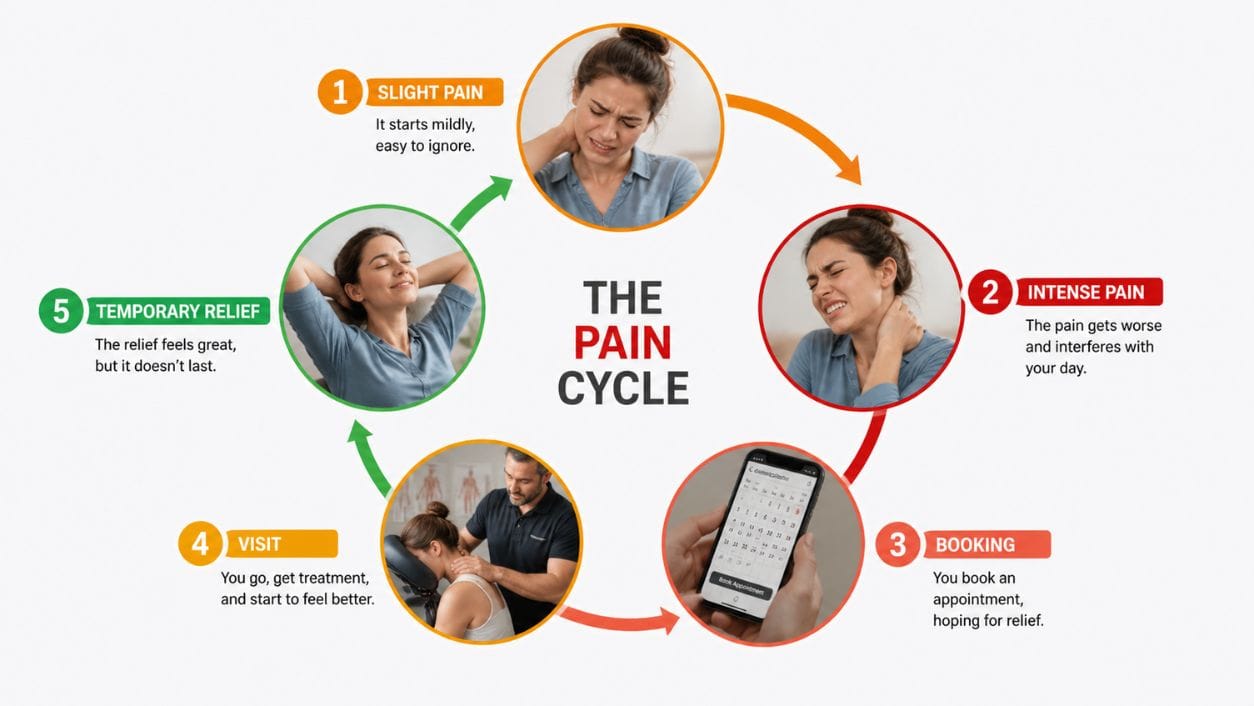
Here's what that adds up to:
Over months and years, the cost of managing a problem that keeps returning — without fixing what drives it — tends to be significant. Not because any single visit is unreasonable. But because you keep going back.
Researchers who reviewed the evidence on sleep-related neck pain found that without addressing the mechanical factors during sleep itself, symptoms reliably return after treatment.²·⁵ The body gets the relief. Then it spends the next eight hours undoing it.
This isn't a marketing claim. It's the conclusion researchers reached after reviewing the available evidence across multiple independent studies.
The most overlooked variable:
Of all the factors involved in sleep-related neck pain, pillow design is one of the few that's present every single night — and one of the few with consistent research support for reducing morning symptoms.²·⁵·⁶
It's not a replacement for treatment when treatment is needed. But for many people, it's the step that should have come first.
And it costs a fraction of what most people have already spent trying to manage the problem without it.

Derila Ergo Pillow wasn't designed around a marketing concept. It was designed around what the research actually identifies as the mechanical factors that matter during sleep.
The Science Behind This Breakthrough:
Studies point to three things that determine how much strain your neck is under at night:²·⁴·⁵
Pillow height — too high or too low keeps the cervical spine out of neutral alignment all night
Contour and shape — a flat surface treats every sleeper the same; the research doesn't support that approach
Consistent support — a pillow that collapses or shifts stops doing its job halfway through the night
The result? A pillow that looks different because it IS different.
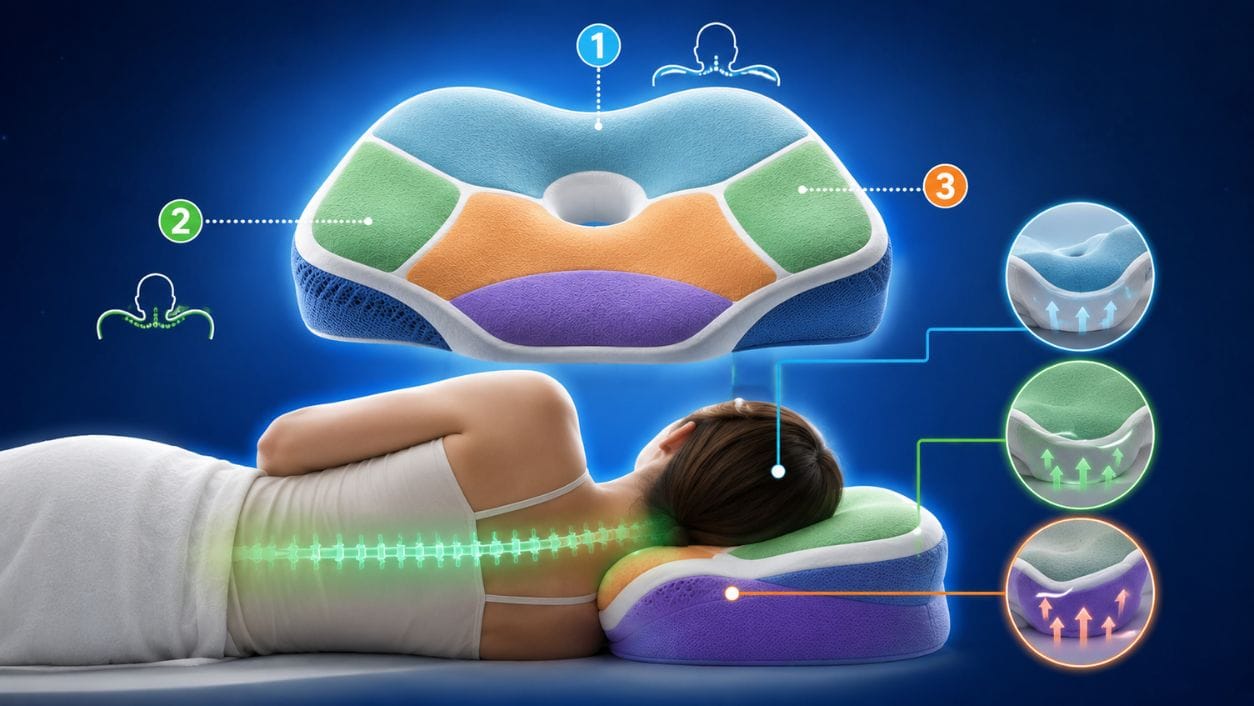
Derila's contoured shape is built around exactly these three factors. The result is a pillow that looks different from a standard one — because it's trying to do something a standard one doesn't.
In studies measuring pillow designs against these criteria, ergonomically contoured pillows with appropriate height and neck support consistently outperformed standard pillows for reducing waking neck pain and morning stiffness.²·⁵
It may look unusual at first. That's because most pillows are designed for comfort in the moment — not for what happens to your neck over eight hours. Those aren't the same thing.
Why the Shape of Your Pillow Changes What Happens to Your Muscles Overnight - That's Changing Lives
Standard pillows are flat. Your neck isn't.
A contoured design distributes the weight of the head more evenly, reduces pressure concentration at the neck and shoulder contact points, and helps maintain the natural cervical curve throughout the night — instead of working against it.
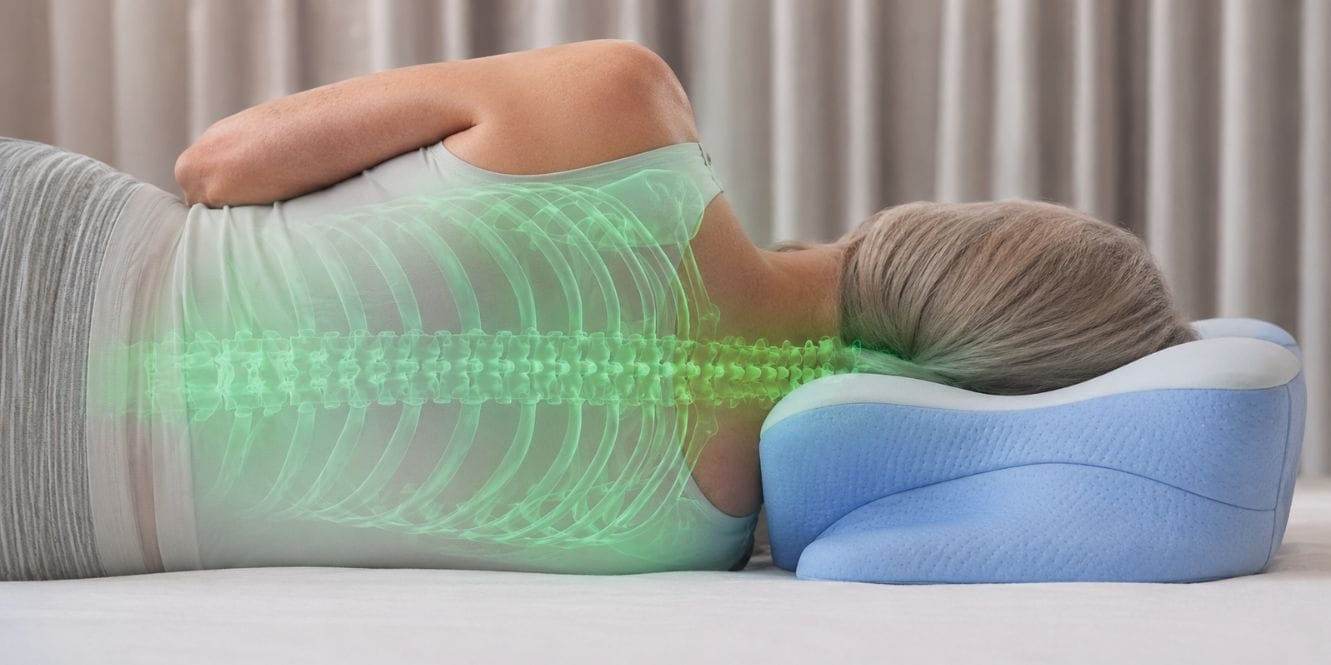
What Research Shows Your Neck Actually Needs at Night
Not every sleeper is the same. And the research reflects that — the right pillow height and support profile depends on how you sleep.²·⁴
Back sleepers? The cervical spine needs to maintain its natural inward curve during the night. Studies show that when pillow height pushes the head too far forward — or lets it drop too far back — neck muscle activity increases measurably and stays elevated through sleep.³·⁴
Side sleepers? The gap between the shoulder and the head needs to be bridged precisely. Too low and the neck bends down. Too high and it bends up. Either way, the muscles compensate all night instead of recovering.³
Stomach sleepers? This position creates the most rotational strain on the cervical spine — researchers consistently identify it as the most problematic for neck symptoms. Any support that reduces that rotation helps.¹·³
What the research consistently points to is this: a pillow that accounts for sleep position — rather than treating every sleeper the same — is more likely to support neutral alignment and reduce morning symptoms.²·⁵
That's what Derila's contoured shape is designed around.
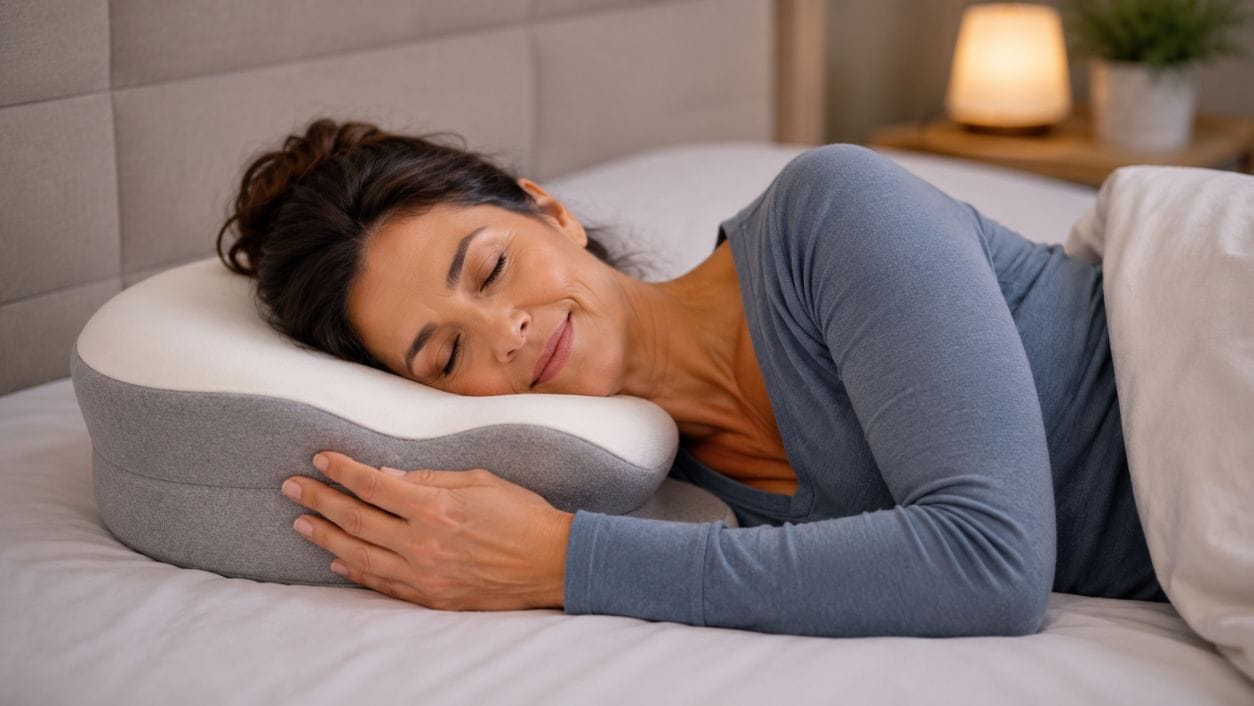
What's Really Happening to Your Neck Right Now
Researchers measuring neck muscle activity during sleep found something that puts the morning pain in a new light: the trapezius and surrounding muscles don't simply switch off when you lie down.
In misaligned positions, they stay active — compensating, holding, working — for hours.³
You don't feel it happening. But eight hours of low-level muscle tension accumulates. And you feel the result the moment you try to turn your head.
Think of it like this: right now, as you're reading this, your neck muscles are probably carrying some tension. Now imagine that tension — not released, not recovered — sustained across eight hours of sleep. That's what poor cervical support does every single night.
WHAT THE RESEARCH SAYS PROPER SUPPORT NEEDS TO DO:
Reduce localized pressure at the neck and shoulder contact points³·⁴
Maintain the natural cervical curve — so muscles aren't working to compensate²·⁴
Stay consistent through the night — support that collapses stops working when you need it most
Match your sleep position — back and side sleepers have different support requirements¹·²
Your body is set up to recover during sleep. The research suggests it just needs the right mechanical conditions to do it.²·⁵
What Happened Over 9 Weeks — Tracked Nightly
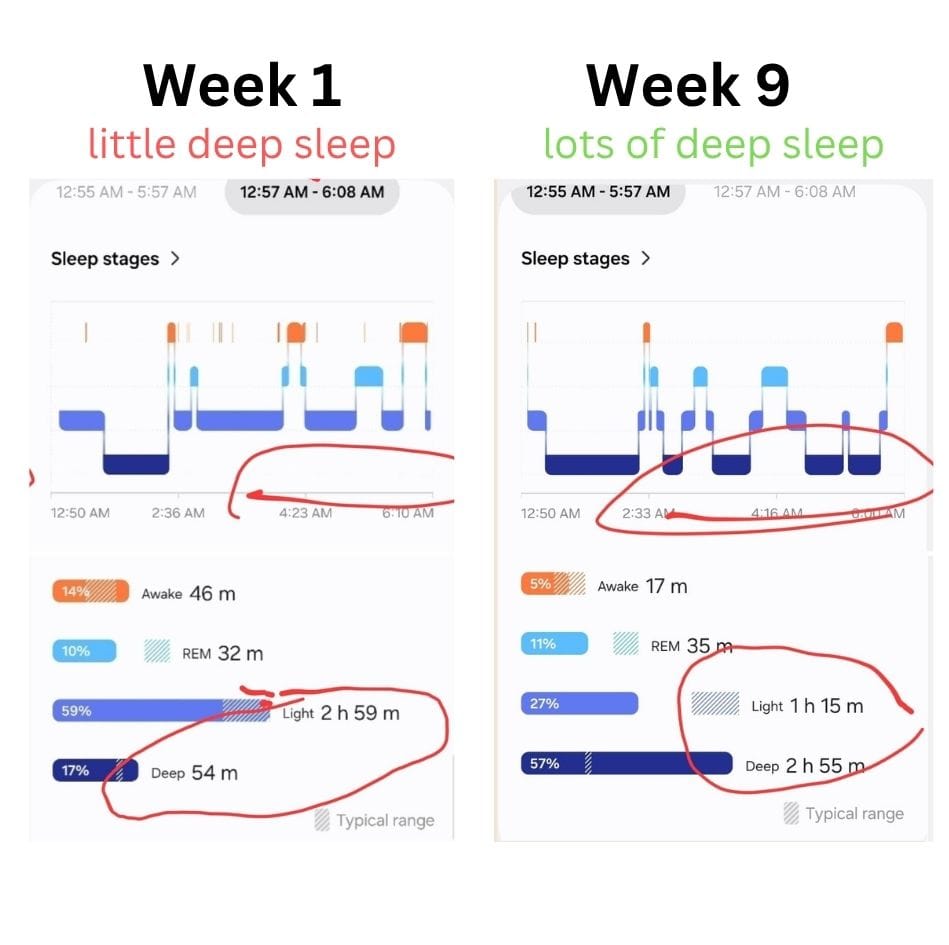
The sleep data below is real. Recorded by a consumer sleep tracker over two separate weeks — nine weeks apart. No lab. No coaching. The only change: the pillow.
Week 1: The Adjustment
The first few nights felt different — but not dramatically so. A new pillow changes the contact points, and the body notices. What shifted more clearly from Night 3 onward: waking up with less of that immediate neck stiffness. Not gone. But noticeably reduced.
The sleep data from Week 1 still showed fragmented sleep — average awake time 3hr 23min, deep sleep just 15 minutes.
Week 5: The Data Starts to Shift
By Week 5, the pattern in the sleep tracker had changed. Less time awake during the night. More consolidated sleep blocks.
This aligns with what researchers have observed in studies on cervical support: when neck muscle tension is reduced during sleep, sleep continuity tends to improve as a secondary effect.²·³ The neck and the quality of sleep aren't separate — they're connected.
🚨 Note: The research suggests the sooner cervical alignment during sleep is addressed, the more consistently symptoms can be reduced over time.²·⁵
Week 9: The Difference in the Data
By Week 9, the comparison speaks for itself:
Average awake time: from 3hr 23min down to 12min
Average deep sleep: from 15min up to 1hr 20min
Morning neck stiffness: significantly reduced
These are personal results from one individual — not a clinical trial. But they reflect what the research predicts: when the mechanical conditions during sleep improve, the body tends to use that time differently.¹·²·⁵
Individual results vary. These screenshots show one person's experience over nine weeks with no other significant lifestyle changes during that period.
[IMPORTANT UPDATE]: Due to current demand, Derila is available at a reduced price for a limited time. Once the promotion ends, it returns to full price.
Derila is currently offering 70% off for first-time buyers.
🏥 The discount is applied automatically — no code needed. Just click the button below.
⚡ Note: Stock levels fluctuate. If the offer page still shows availability, you're in time.
What Are Other People Saying About Derila pillow?
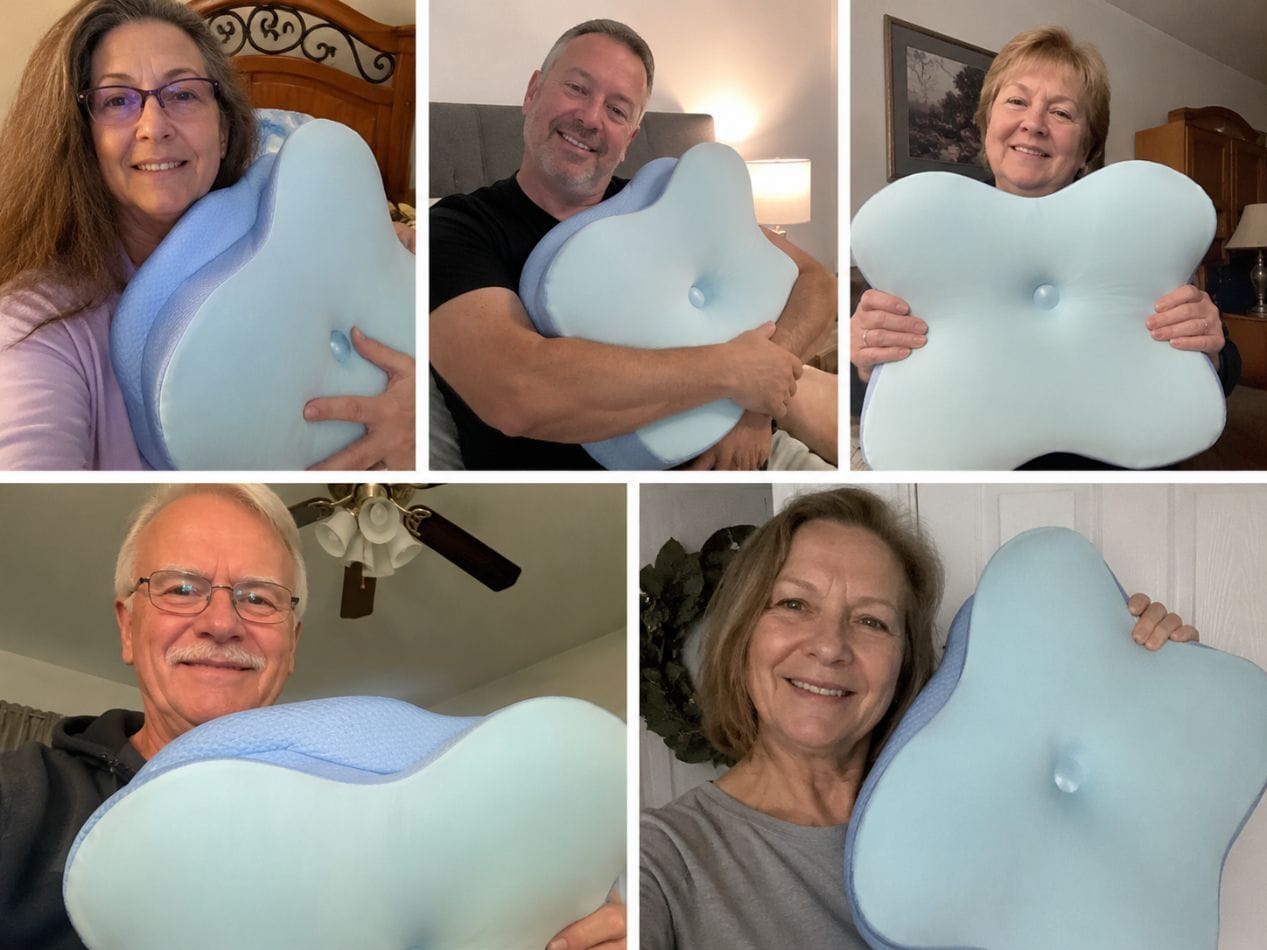
JamesR, CA


I've been a side sleeper my whole life and always woke up with a stiff neck. Tried two other 'ergonomic' pillows before this one — neither made a real difference. With Derila it took about a week to adjust, but by week two I noticed I wasn't doing that morning neck-roll routine anymore. Not a miracle, but a genuine improvement.
Michelle T, UK
Honestly bought this expecting nothing. I've had chronic neck tension for years and figured it was just how things were. After about 10 days I realized I was waking up and just... getting out of bed. No stiffness check, no easing into it. Still can't fully explain it but the difference is real.
David K, US
I sit at a desk all day so my neck and shoulders are already tight before I even get to bed. The Derila doesn't fix that — but it stops the nights from making it worse. That alone is worth it for me. My mornings are noticeably easier than they were.
Sandra B, GER
I used to wake up multiple times a night with both hands completely numb. I'd shake them out, wait for the feeling to come back, then try to fall asleep again. Every single night.
After a few weeks with the Derila pillow, it still happens occasionally — but nowhere near as often. I hadn't expected that.
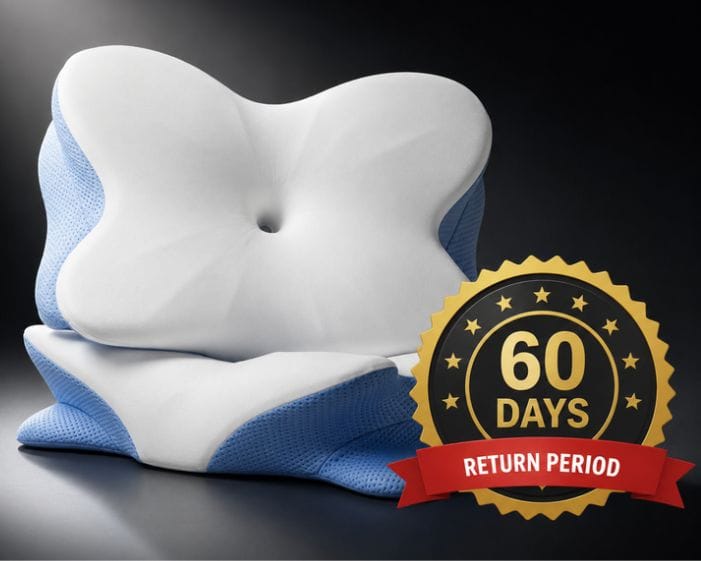
Derila offers a 60 day return period
You don't have to take anyone's word for it. Try it for up to 60 days — if you notice no difference, send it back for a full refund. No hassle, no questions asked.
The risk is entirely on the manufacturer's side. Not yours.
Think about what you've already spent managing this problem. A massage here. A physio session there. A chiropractic visit when it gets bad. Each one is reasonable on its own — but they add up.
And because none of them change what happens during the eight hours you spend in bed, you keep going back.
Derila is a one-time purchase. And it costs less than most people spend on a single month of treatment.
The difference? Those treatments address the result. Derila addresses what the research identifies as the cause — the mechanical conditions during sleep itself.²·⁵
Join over 100,000 customers who've already made the switch.
Comments
JanMe
The article made a lot of sense to me. I've been dealing with neck stiffness for years and never thought the pillow was the issue. Going to give this a try.
KimD
I was skeptical — I've tried a lot of pillows and none of them made a real difference. I have ongoing neck issues and sleep had become something I dreaded rather than looked forward to. After a few weeks with Derila I'm sleeping longer and waking up with noticeably less pain in the morning. Not what I expected, honestly.
Surprise_23
I'd spent a lot on various treatments over the years with limited results. Found Derila almost by accident. I wasn't expecting much — but it's made a real difference to how I feel in the mornings. Back and neck both feel better. Sleep quality has improved noticeably.
SandraB
Straightforward article, well researched. Nice to see something practical recommended instead of expensive treatments. Good work.👏🏻🤩
Gbock
Ten years of neck pain and more pillows than I can count. This is the first one where I've consistently woken up without that stiff neck feeling. I'm a back and side sleeper so finding something that works for both was the main thing. Really pleased with it.
Morrison_mike
Product is exactly as described, delivery was fast and on time. The pillow itself is comfortable — not too firm, not too soft. I've tried a few recently that were way too rigid. This one feels right. Happy with the purchase.

This site is not a part of Google LLC or Facebook Inc.
This site is not endorsed by Google or Facebook in any way.
¹ Cary et al. (2021), PLOS ONE — doi.org/10.1371/journal.pone.0260582
² Pang et al. (2021), Clinical Biomechanics — pubmed.ncbi.nlm.nih.gov/33895703
³ Lee & Ko (2017), JPTS — doi.org/10.1589/jpts.29.1021
⁴ Kim et al. (2015), Korean J Spine — doi.org/10.14245/kjs.2015.12.3.135
⁵ Radwan et al. (2021), Eur J Integr Med — doi.org/10.1016/j.eujim.2020.101269
⁶ Ferrer-Peña et al. (2025) — doi.org/10.1016/j.rh.2025.100922
This is an advertisement and not an actual news article, blog, or consumer protection update.
MARKETING DISCLOSURE: This website is a market place. As such you should know that the owner has a monetary connection to the product and services advertised on the site. The owner receives payment whenever a qualified lead is referred but that is the extent of it.
ADVERTISING DISCLOSURE: This website and the products & services referred to on the site are advertising marketplaces. This website is an advertisement and not a news publication. Any photographs of persons used on this site are models. The owner of this site and of the products and services referred to on this site only provides a service where consumers can obtain and compare.
The information on this page is for informational purposes only and is not intended as medical advice. Always consult a qualified healthcare provider regarding any health concerns.
Results may vary. We do not guarantee specific results.
This page contains affiliate links. We may earn a commission if you purchase through our links at no additional cost to you.