
Vital Living Insights Editorial Team
Updated April 2026 | 4 min read
Informational article - not medical advice
Vital Living Insights Editorial Team
Updated April 2026 | 4 min read
Informational article - not medical advice
Buyer's Guide — Neck Support Pillows
Not All "Neck Pillows" Actually Support Your Neck. Here's What to Look For.
Most pillows marketed for neck pain look similar — but only a few are designed around the one thing that actually matters: keeping your cervical spine in a neutral position while you sleep.

Not All "Neck Pillows" Actually Support Your Neck. Here's What to Look For.
Most pillows marketed for neck pain look similar — but only a few are designed around the one thing that actually matters: keeping your cervical spine in a neutral position while you sleep.
THE PROBLEM WITH THE MOST PILLOWS
Why Standard Pillows Fall Short for Side Sleepers With Neck Pain
Most standard pillows aren't designed around this. They're designed for comfort and softness.
That's a different goal. A pillow that feels good when you lie down may still let your head tilt sideways by several centimeters throughout the night — and that tilt adds up over 7–8 hours.
When you sleep on your side, there's a gap between your shoulder and your head.
A pillow's job is to fill that gap precisely — so your head stays level and your cervical spine stays straight.
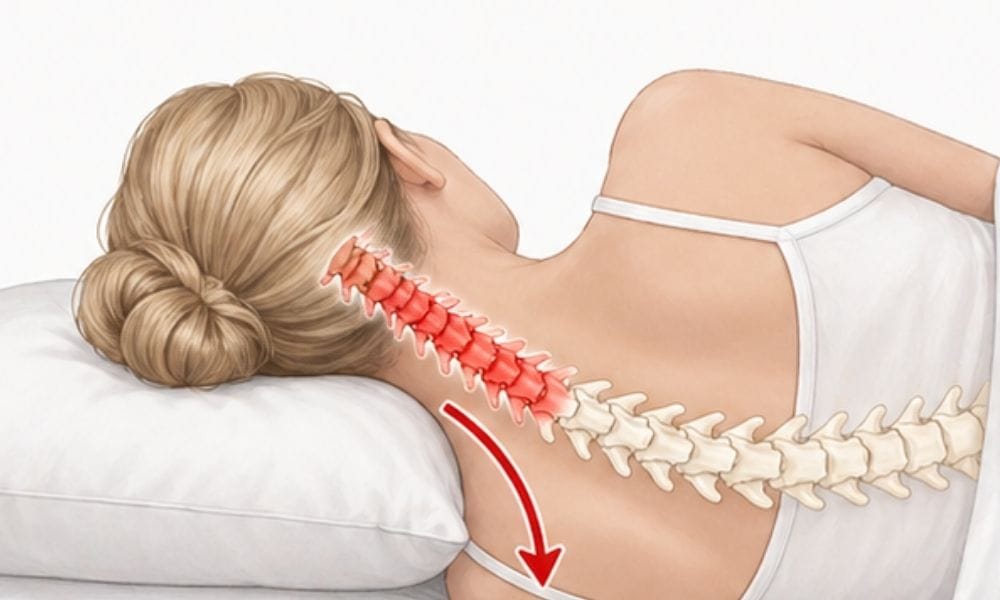
The result: your neck muscles work all night trying to compensate. You wake up stiff, tight, and already tired — even after a full night's sleep.
WHAT THE RESEARCH POINT TO
What Sleep Posture Research Actually Says
Studies on cervical spine alignment during sleep consistently identify two design factors that matter most:
What to Look For in a Neck Support Pillow
Correct fill height for your sleep position — side sleepers typically need more height than back sleepers to maintain neutral alignment
Contoured or cervical shape — a pillow with a curved profile keeps the neck in a consistent position instead of shifting throughout the night
Adaptive support, not just softness — the pillow should support the head's weight without collapsing or pushing back too hard
Consistent loft throughout the night — a pillow that flattens by 2–3 cm at 3am is no longer doing its job
Sources: Persson et al., Journal of Pain Research, 2011 | Gordon et al., J Manipulative Physiol Ther, 2009
Standard vs. cervical support — side by side
What's Actually Different
Feature
Standard Pillow
Cervical Support Design
Shape
Flat or uniform
Contoured for neck curve
Fill height
One-size, often collapses
Designed for side-sleeping gap
Neck muscle load
High - compensates all night
Low - spine held in position
Sleep disruption
Frequent position changes
Less tossing and turning
Morning stiffness
Common
Reduced over time
Shape
Standard Pillow
Flat or uniform
Cervical Support
Contoured for neck curve
Fill Height
Standard Pillow
One-size, often collapses
Cervical Support
Designed for side-sleeping gap
Neck Muscle Load
Standard Pillow
High - compensates all night
Cervical Support
Low - spine held in position
Sleep disruption
Standard Pillow
Frequent position changes
Cervical Support
Less tossing and turning
Morning Stiffness
Standard Pillow
Common
Cervical Support
Reduced over time
*Individual results vary. This comparison reflects general design principles based on cervical biomechanics — not a guarantee of specific outcomes for any individual.
"Once I understood that my pillow was letting my head tilt sideways all night, the stiffness made complete sense. The geometry was off for eight hours straight — every single night."
Jennifer M., 47, nurse from Ohio — submitted via reader feedback form
This reflects one individual's experience. Results vary. Not medical advice.
WHAT's ON THE NEXT PAGE
What You'll Find Out on the Next Page:
A detailed look at one cervical support pillow designed specifically for side sleepers — including honest user reviews (mixed results included)
Which design features set it apart from standard memory foam pillows
Who it's likely to help — and who might not see much difference
Whether it's worth the price compared to alternatives
More on the next page.

Sources: Persson L. et al. — "The effect of pillow height on neck and shoulder muscle activity, cervical range of motion and sleep quality." Journal of Pain Research, 2011. | Gordon S. et al. — "A randomized, comparative trial of two pillows." J Manipulative Physiol Ther, 2009. | American Chiropractic Association — Back & Neck Pain Statistics.
The information on this page is for informational purposes only and is not intended as medical advice. Always consult a qualified healthcare provider regarding any health concerns. Results may vary. We do not guarantee specific results. This page contains affiliate links. We may earn a commission if you purchase through our links at no additional cost to you.
This site is not a part of Google LLC or Facebook Inc.
This site is not endorsed by Google or Facebook in any way.
The information on this page is for informational purposes only and is not intended as medical advice. Always consult a qualified healthcare provider regarding any health concerns.
Results may vary. We do not guarantee specific results.
This page contains affiliate links. We may earn a commission if you purchase through our links at no additional cost to you.