
Vital Living Insights Editorial Team
Updated April 2026 | 4 min read
Informational article - not medical advice
Vital Living Insights Editorial Team
Updated April 2026 | 4 min read
Informational article - not medical advice
You Sleep 7–8 Hours — And Still Wake Up With Neck Pain. Here's Why.
It's not the stress. Not your age. Not your mattress. Most people spend years overlooking the real cause — even though they sleep directly on top of it every single night.

More on the next page.
Morning after morning, the same thing: eyes open — and immediately, the neck. Most people think that's just normal. It isn't.
The alarm goes off. You open your eyes. And before you've even moved a muscle: that dull pull in your neck. Again.
You slowly turn your head left, then right, waiting for the crack. Then your shoulder. Then your back.
Coffee. And the same thought again: "I slept. So why do I feel like this?"
Maybe you know this feeling too: the pressure behind your eyes that lingers until noon. The shoulder that aches the moment you sit down at your desk.
That sense of starting the day already exhausted — even though you spent enough hours in bed.

"I sleep 8 hours and still wake up wrecked. What's wrong with me?"
The problem isn't you — it's what's under you. Every night.
Coffee. And the same thought again: "I slept. So why do I feel like this?"
Maybe you know this feeling too: the pressure behind your eyes that lingers until noon. The shoulder that aches the moment you sit down at your desk.
That sense of starting the day already exhausted — even though you spent enough hours in bed.
The alarm goes off. You open your eyes. And before you've even moved a muscle: that dull pull in your neck. Again.
You slowly turn your head left, then right, waiting for the crack. Then your shoulder. Then your back.
"I sleep 8 hours and still wake up wrecked. What's wrong with me?"
The problem isn't you — it's what's under you. Every night.
THE CAUSE - SIMPLY EXPLAINED
What Your Pillow Is Doing to Your Spine Every Single Night
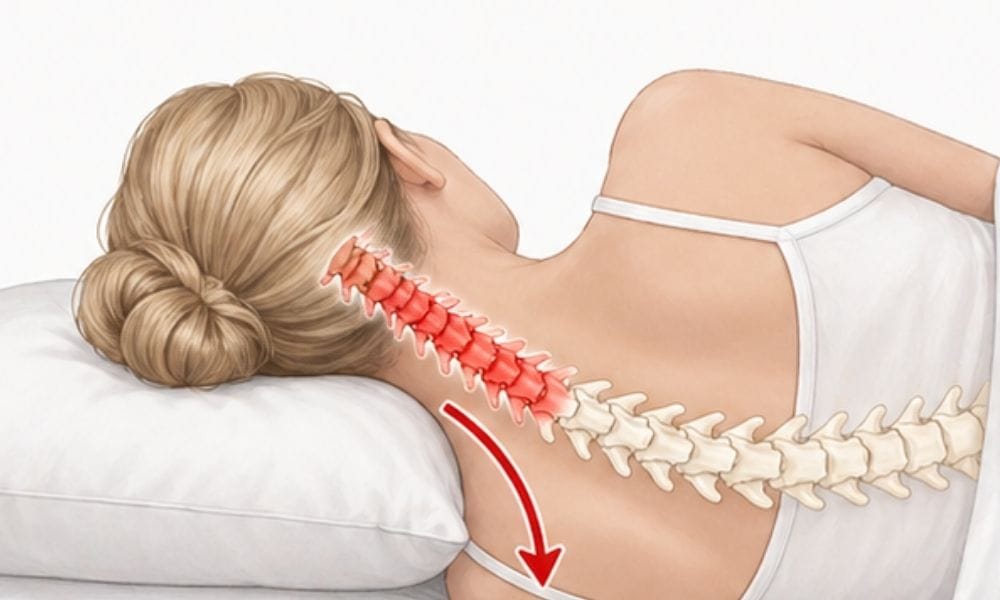
When you sleep on your side and your pillow is too thick or too firm, your head gets pushed too high. Your cervical spine bends upward — away from its natural, neutral alignment. And that happens hour after hour, all night long.
Your neck muscles are actively working while you sleep, trying to stabilize your head. You don't feel it in the moment — but in the morning, you feel the result. Stiffness. Tension. Pressure. Exhaustion.
And because the position stays uncomfortable, your body keeps tossing and turning all night. No real deep sleep. No real recovery. No matter how many hours you lie there.
This mechanism is documented in sleep posture research — see: Persson et al., Journal of Pain Research, 2011; Gordon et al., Journal of Manipulative and Physiological Therapeutics, 2009
Neck and shoulder tension in the morning — caused by hours of misalignment throughout the night
Headaches and pressure when you wake up — often linked to sustained tension
Disrupted sleep and frequent position changes — your body shifts because it can't find a comfortable position
Tired, irritable, unfocused during the day — a common downstream effect of fragmented, low-quality sleep
More on the next page.
THE DIFFERENCE — UP CLOSE
Regular Pillow vs. Proper Neck Support: What's Happening While You Sleep
REGULAR PILLOW
Head drops sideways in side-sleeping position
Cervical spine stays bent at an angle
Neck muscles work all night
Constant tossing and turning
Morning: stiffness, tension, exhaustion
WITH PROPER NECK SUPPORT
Head held at the correct height
Cervical spine stays in a neutral position
Neck muscles can actually relax
Less turning — more deep sleep
Waking up with less stiffness over time
*Individual results vary. This comparison reflects general design principles based on cervical biomechanics — not a guarantee of specific outcomes for any individual.
This isn't a product pitch. This is biomechanics. When your head spends eight hours a night in a misaligned position, it adds up. The good news: the cause is mechanical — and so is the fix.
SOUND FAMILIAR?
"I got a new mattress. I stretch every morning. I've tried three different pillows. Nothing sticks."
That's not bad luck. Mattresses and stretching don't address the root cause — they don't change the position your cervical spine is in for eight hours every night. Most pillows are designed for comfort, not for cervical spine support in a side-sleeping position.
THE FIX
There's a Simple Cause — and a Simple Solution
The cause is mechanical. So is the fix. When your head is held at the right height during the night, your neck muscles can relax. Your body stops searching for a better position. Deeper, more uninterrupted sleep becomes possible. And mornings can start to feel different.
A growing number of people dealing with exactly this — neck tension, stiffness, broken sleep — say that one small change to their sleep setup made a noticeable difference.

What You'll Find Out on the Next Page:
Why most standard pillows don't address cervical alignment — and what to look for instead
What sleep posture researchers identify as the primary cause of morning neck tension
A practical overview of one product designed specifically for this — with honest user feedback, including mixed reviews
Whether this type of solution is likely to be a good fit for your situation
More on the next page.
THE FIX
There's a Simple Cause — and a Simple Solution
The cause is mechanical. So is the fix.
When your head is held at the right height during the night, your neck muscles can relax.
Your body stops searching for a better position. Deeper, more uninterrupted sleep becomes possible. And mornings can start to feel different.
A growing number of people dealing with exactly this — neck pain, stiffness, broken sleep — say that one small change to their sleep setup made a noticeable difference.
What You'll Find Out on the Next Page:
Why most standard pillows don't address cervical alignment — and what to look for instead
What sleep posture researchers identify as the primary cause of morning neck tension
A practical overview of one product designed specifically for this — with honest user feedback, including mixed reviews
Whether this type of solution is likely to be a good fit for your situation
More on the next page.
WHAT REAL PEOPLE ARE SAYING
"I thought waking up stiff was just part of getting older. It wasn't until I learned about cervical alignment during sleep that I realized something very fixable was happening every single night. Changing my pillow was the most practical improvement I'd made in years."
— Jennifer M., 47, nurse from Ohio - submitted via reader feedback form
This reflects one individual's personal experience. Results vary from person to person. This is not medical advice. If you have ongoing pain or sleep issues, please consult a qualified healthcare professional.
Find out if this applies to you on the next page. Just click the blue button above. It takes less than 2 minutes.
Sources:
Persson L. et al. — "The effect of pillow height on neck and shoulder muscle activity, cervical range of motion and sleep quality." Journal of Pain Research, 2011. | Gordon S. et al. — "A randomized, comparative trial of two pillows." J Manipulative Physiol Ther, 2009. | American Chiropractic Association — Back & Neck Pain Statistics.
This site is not a part of Google LLC or Facebook Inc.
This site is not endorsed by Google or Facebook in any way.
The information on this page is for informational purposes only and is not intended as medical advice. Always consult a qualified healthcare provider regarding any health concerns.
Results may vary. We do not guarantee specific results.
This page contains affiliate links. We may earn a commission if you purchase through our links at no additional cost to you.